AI Sprints are about people, stories and truth. So often in education, we hear from people who claim to predict the future by describing the present, and they do it with such conviction. Somewhere in the noise lie the reliable voices. Those who have genuine stories to tell, ones of transformation and hope. This is why I started the AI Sprints – to surface the stories worth telling, and to give people a space to share them.
If you are curious what an AI Sprint is, I will do my best to define it. In essence, it’s a fast-paced exploration into the issues and ethics that surround artificial intelligence (AI). It’s not a podcast as it’s a live event. It’s also not a webinar or a workshop. Instead, it’s a live community event that opens the door to critical dialogue, ideas and a healthy dose of honesty about a technology that is evolving faster than many of us would like. The narrative is grounded in the school and centres as it should be, around the ‘child’. As we approach the end of Season 2, I feel proud of what it has become.
AI Sprints has an origin story
Picture this: an online STEM Community event about AI, with hundreds of people tuned in from all corners of the world. The energy was electric. For a full hour, we explored the world of artificial intelligence together, and the audience was captivated. Nobody left. By the time we wrapped up, the comment section had exploded with over 800 messages. People were curious, excited, and hungry for more. Questions were flying, ideas were bouncing around, and it became crystal clear that this conversation was just getting started. That's when the AI Sprints were born. What began as a single live event took on a life of its own.
I am deeply fascinated how ideas that are shared in one setting find new life in another. The live sprints have become a testing ground for ideas and a space to share disruptive and at times, where money is scarce, frugal innovation.
As with many live experiences, the guests shape the narrative. My role as host is to find the authentic people and help share their insights. I am part journalist, part script writer, and then there is the delicate matter of the questions – how to provoke just enough in the right places, at the right time. I try to ask questions with just enough bait for the ideas to reveal themselves, then I nod, wait and smile, and let silence do the heavy lifting. From my years working as both a teacher and a researcher, I have learned that the truth frequently reveals itself not in words, but in the spaces between them. I refer to these as the silences. Hosting is equal parts therapy, trust and the occasional trick. Some days it flows. Other days, you must work a little harder and prompt in the right places.
Finding the reliable voices in education
The methodology for the Sprints was to seek out the most reliable voices. These people are often found on the fringes of education, acting alone. In a profession so resistant to change, innovation can often be seen as an act of defiance. I see it as an act of love. I have always admired those folks who have the courage to disrupt from the inside out. They have mastered the art of being agile within the box. Conversely, there are those who work in groups, or communities, and they are interesting too.
When I reflect on the episodes to date, it fills me with hope. Education is full of people who care deeply. In this sense, the AI Sprints beautifully enacts its own thesis. Both what we notice and how we think about noticing matter.
Reflecting on the journey so far
Communities of practice can be transformative in education. I think as humans we are conditioned to be critical, it’s our default setting. Opening space to hear new voices can challenge our worldview and expand our knowledge beyond our familiar ‘echo chambers’. I have learned so much from the guests I have spent time with. For example, Laura Knight’s poignant assurance that we need to ‘think with care’ when it comes to AI has stuck with me. There are others too. Too often those at the forefront of AI speak with a perfect certainty. However, it’s refreshing to hear from people who don’t know. This has given me an unshakable conviction that education values truth, and often we find it in the most unexpected places.
AI Sprints episodes to date have illustrated that there is an appetite for alternative conversations around this technology. For most of the sprints, other aspects of teaching were the central focus. Darren Coxon, Priya Lakhani and Dr Kate Pardine championed ‘voice’ as a transformational force for good in the classroom. Teachers should be speaking to children more. Lord Jim Knight and Daisy Christodolou spoke about knowledge, and Bukky Yusuf and Al Kingsley showed us how bias, a flaw as old as time itself, is ever present in everything we do. These are very ‘human problems’, exemplified by AI rather than problems defined or created by it.
BETT as a testing ground
Last week, STEM Learning took a brave step by bringing the AI Sprints to BETT. I felt extra pressure as it was my idea. I wanted to test whether the vibrant online community could work in a live in-person setting. BrainFreeze, long time sponsors of the Sprints kindly offered to host us on their stand. The setting gave us a presence at BETT to share more stories. In the weeks leading up to the event, I worried if anyone would show up to listen. But they did show up. Not just a handful of curious passersby, but people who were there to see it live. At times it was standing room only, with people pressed shoulder to shoulder, leaning in to catch every word. And here's what struck me most: very few people left. They stayed, engaged, asking questions, sharing their own experiences. At one session, a woman stood beside another attendee, gracefully signing throughout the entire presentation to ensure that everyone could be part of the conversation. It was a beautiful reminder of what inclusive engagement truly looks like, and it made our captive audience even richer for it.
I feel incredibly privileged that so many people chose to give us 30 minutes of their time at BETT, a show where every minute counts and there's always somewhere else to be, something else to see. That they stopped, stayed, and became part of our conversation means everything. I was spirited by the support the education community gave us at a time when there is so much noise and uncertainty. It was also great to welcome back previous guests and meet so many people in person, people who have become fierce and loyal Sprinters themselves.
A final conviction that proved that AI Sprints can exist in new formats came when Trudi Barrow and Aaaron Patching took the stage on day 2 of the conference. Rather than express in words the gratitude people felt when this session ended, I thought I would share the image below. Theirs is a story people wanted to hear. A live walkthrough of some of the most creative ways that teachers are using AI to enhance students' work. Pure brilliance!
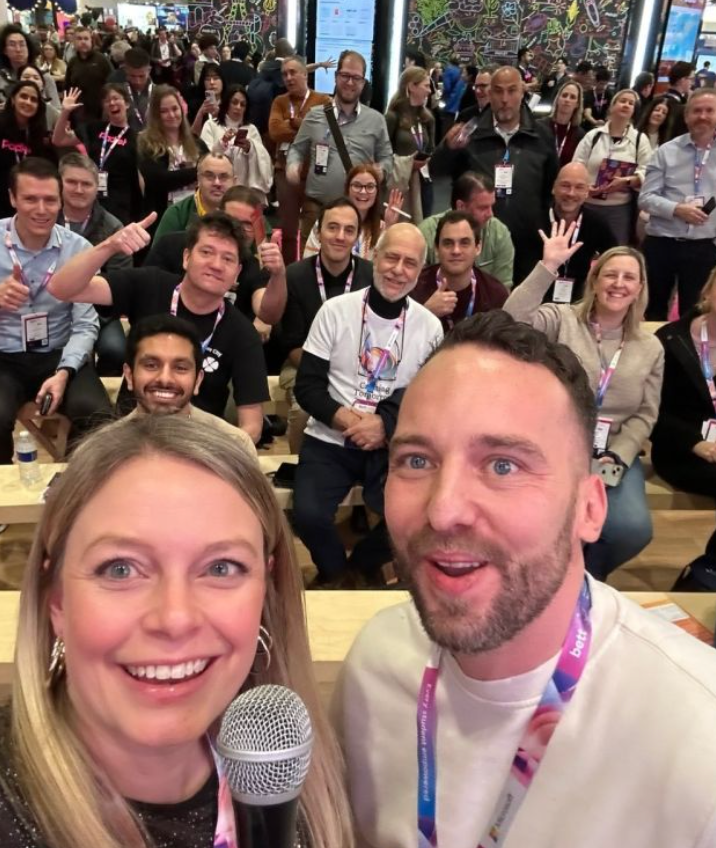
The AI Sprints have proven that authentic conversations about AI in education matter. When we create space for honest dialogue, grounded in real classroom experiences and centered on children, people show up. They listen. They stay. And together, we find the stories worth telling, the ones that transform education from the inside out.
How to join future AI Sprints
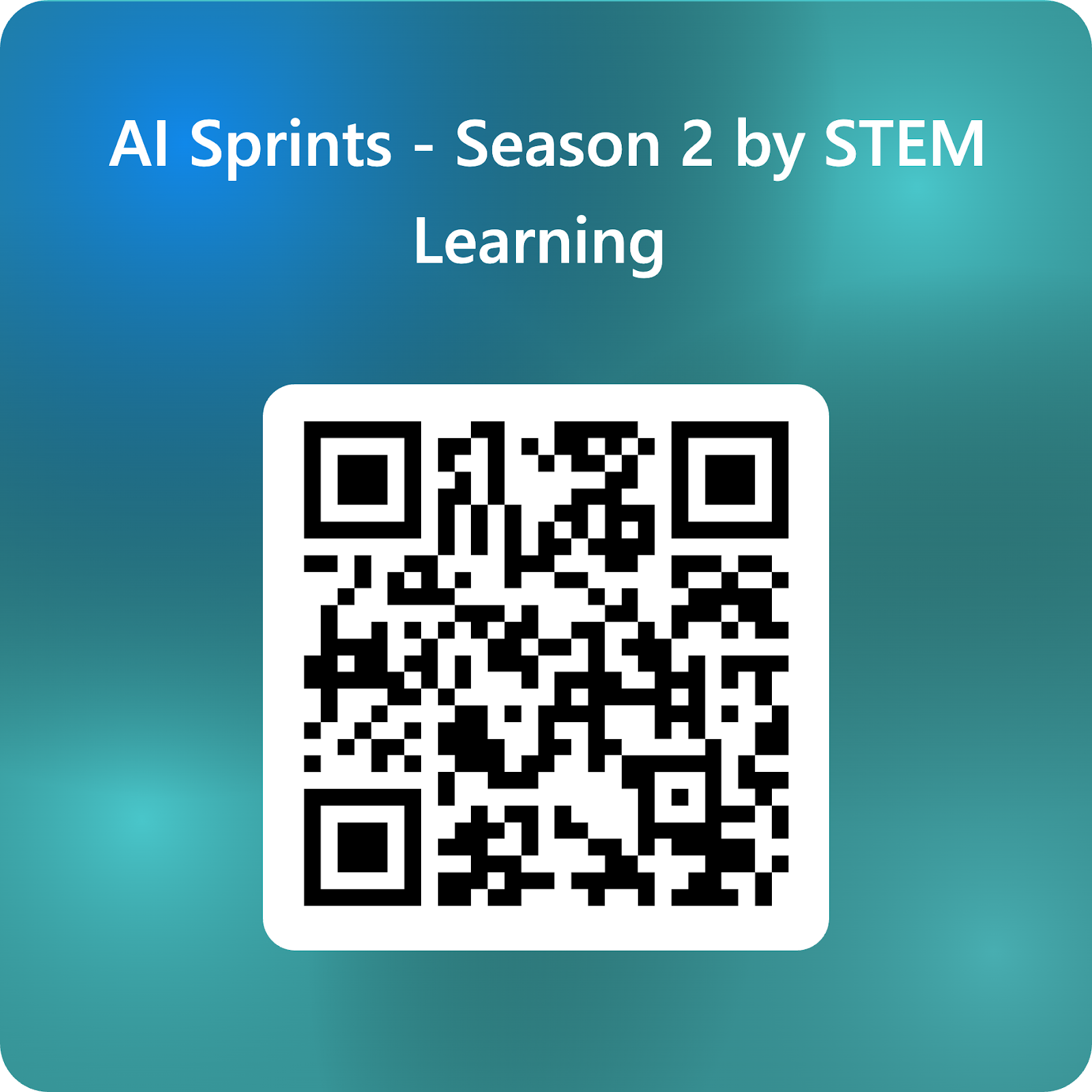
If you would like to join in future episodes of AI Sprints, simply scan the QR code below or sign up via this link for free: https://forms.office.com/e/LSgh5MBUH3
Upcoming Episodes: Online
26/02/26: AI in assessment revisited with Christian Turton & Julie Carson
16/03/26: The environmental impact of AI with Rita Bateson & Rachel Bodily
Catch -up on Demand
Like your favourite Netflix show, you can catch up on demand here via the STEM Learning community page: https://community.stem.org.uk/browse/scl-od
Previous episodes:
Season 1
Darren Coxon & Priya Lakhani MBE- AI and student voice
Lord Jim Knight & Daisy Christodolou - AI and the future of assessment
Laura Knight & Jon Chippendall - Thinking with care when it comes to AI
Bukky Yusuf & Al Kingsley OBE - Ethics and Bias
John Dolman & David Curran - Practical AI test cases in the classroom
Season 2
Tom Sherrington & Joe Jackson Taylor - AI and metacognition
Dr Kate Paradine & Daniel Emmerson - Oracy, the Digital Divide & AI Equity
Emma Darcy & Mark Anderson - Assessment and Feedback